

When the power goes out, light is usually the first thing you notice missing. A phone flashlight and a couple of candles can carry you through a short power outage, but once it stretches past an hour or two, that setup starts to show its limits, especially if you need to cook, calm children, or step outside to check what happened.
This guide covers practical lanterns, flashlights, and headlamps that keep a home usable during a blackout, and how they fit into a broader blackout preparedness plan alongside a portable power station and a solid emergency kit.
Why Dedicated Emergency Lighting Still Matters
A phone is excellent for communication, news, and apps, but it is a poor primary light source once an outage runs long. Every minute the screen stays on as a flashlight is battery you may need later, for reaching family or checking outage updates.
Dedicated lanterns and flashlights remove that trade-off. They give a room safe, steady light without draining a phone, put a focused beam where it is needed for a breaker panel or a valve, and free up both hands when a headlamp is doing the work instead. The difference is a home that feels merely inconvenient rather than one that feels genuinely dark and stressful.
Lanterns, flashlights, and headlamps: what each one is for
A small, well-chosen set of lights covers a household far better than a drawer full of random gadgets, and the three main types are not interchangeable. Each does a different job.
A lantern throws light in every direction and is what keeps a living room or kitchen usable through an evening. Eating, reading, and getting children settled all happen more calmly under one steady lantern than under a scattering of phone screens. Something in the 200 to 500 lumen range is usually enough to make a room comfortable without turning it into an operating theatre.
A flashlight is for tasks that need a directed beam rather than ambient light: inspecting the breaker panel, checking a shed or garden after a storm, walking to a neighbour’s house. A compact LED flashlight with a few brightness levels is more useful around the home than a large tactical torch built for outdoor distance.
A headlamp earns its place the moment both hands are busy. Cooking, caring for a child at night, or working on plumbing all go more smoothly with light on your forehead instead of in your hand, and a headlamp deserves a fixed spot in any 72-hour emergency kit. They put light exactly where you look and keep your hands free.
What actually matters when choosing one
Power source decides how usable a light stays once an outage runs past a day. AA or AAA battery models are simple to restock from the same emergency supplies you already keep. A built-in rechargeable battery is convenient day to day and easy to top up from a portable power station, and a hybrid design that takes both gives the most flexibility for an extended outage. When comparing runtimes, look past the figure quoted for the brightest turbo setting. What matters is how long a light lasts on low or medium, since that is the mode you will actually use for most of a multi-day blackout.
Brightness matters less than people assume. Forty to a hundred lumens is enough for a small area, two to three hundred lights a modest room comfortably, and three to six hundred covers a larger room or a work area. A handful of well-spaced brightness levels, including an efficient low mode that runs for days rather than hours, matters more than one blinding turbo setting. Strobe modes rarely see any real use at home; calm, steady light is what actually gets used.
Storms, heatwaves, and heavy snow are exactly the conditions that cause the largest outages, so the lighting itself needs to survive them. A solid housing rather than thin, creaky plastic, at least basic water resistance for anything used outdoors, and a stable base or hook so nothing topples in the dark, are all worth checking before buying. These are tools that may sit untouched for months and then get put to work exactly when stress is already high, so simple, obvious controls matter as much as brightness. A light that needs a specific click pattern to reach the mode you want is not one you want to be fumbling with in a dark hallway.
A practical set for most homes
A Streamlight Siege makes a solid main lantern, the one you switch on first to make the house feel normal again: 360-degree LED output up to 600 lumens, a rechargeable battery with AA or D backup, a stable base and hook, and USB-C charging with an optional power-bank function for phones.

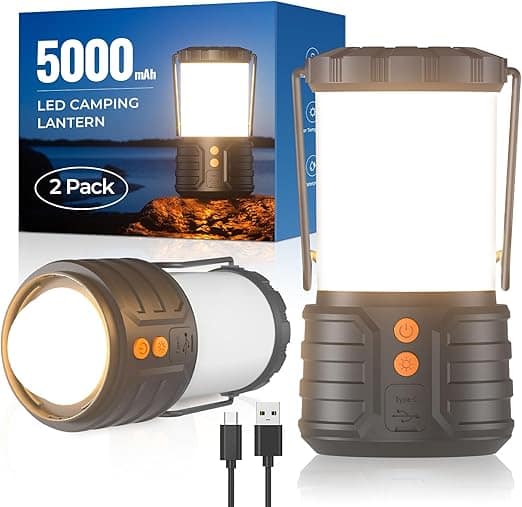
For covering several rooms at once, a collapsible lantern two-pack is a cheap way to put a light in every bedroom, the hallway, and the bathroom without spending premium-lantern money. Build quality is simpler, but once an outage runs past one night, light in every room usually matters more than any single feature.
A Streamlight Microstream covers the inspection and outdoor-check role well, with up to 1,000 lumens, a usable low mode, and a simple side switch. Keep one near the front door, one by the breaker panel, and one in the emergency kit itself.

A Black Diamond headlamp with an adjustable strap and at least two brightness levels plus a low mode handles cooking, repairs, and carrying things up and down stairs hands-free, and pairs naturally with an emergency radio as part of the same kit.

A small backup light like the Nitecore Thumb will not light a room, but it bridges the gap between everything being dark and finding the main lantern, and costs nothing to keep on a keyring or in a bedside drawer.

How much light a household actually needs
A realistic baseline is two main lanterns for the living area and kitchen, a budget lantern set for the remaining bedrooms and bathrooms, two flashlights by the front door and the breaker panel, a headlamp per adult, and a few small backup lights in obvious spots. The goal is simply that every important room has a reliable light source and every adult has a hands-free option within reach.
Lighting works best as one piece of a wider plan that also covers water storage, a realistic emergency food supply, a 72-hour emergency kit, backup power for phones and routers, and an emergency radio for staying informed. None of it needs to happen at once. A main lantern, a flashlight by the door, and a headlamp per adult is enough to start, with the rest of the kit built out at your own pace.
Still looking for more inspiration? Check our Amazon Store