

A bug out bag is a packed, portable kit you can grab and go with when leaving home quickly is the right decision. It is not a hiking pack or a camping bag repurposed for emergencies. It is a dedicated kit built around one specific scenario: getting your household from home to somewhere safer when staying put is not a viable option.
Most households that have a bug out bag assembled correctly find they rarely need it. The value is not in daily use. It is in having it ready on the one occasion where the difference between leaving in five minutes and leaving in forty-five minutes matters.
This Bug Out Bag checklist covers what a practical, household-focused bug out bag contains, how to think about weight and size, and how it fits alongside the rest of your emergency preparation.
Bug out bag versus 72-hour kit: what is the difference
The terms overlap enough to cause confusion and it is worth being direct about the distinction.
A 72-hour emergency kit is typically a home-based supply: stored water, shelf-stable food, a first aid kit, lighting, and a radio kept in a known location at home. It is designed for shelter-in-place scenarios where you stay at home through a disruption.
A bug out bag is designed for the opposite scenario. It is a portable kit you carry on your back or in a vehicle when you need to leave. The contents overlap with a home kit but the format is completely different. Weight, portability, and self-sufficiency over 72 hours away from home are the constraints that shape every decision.
Some households use the terms interchangeably and have a single kit that serves both purposes. That is a reasonable approach for a flat or small household. For larger households or anyone who wants both shelter-in-place and evacuation capability covered properly, they are two separate kits.
How heavy should a bug out bag be
This is the question most checklists skip, and it determines whether the bag is actually usable.
The standard guidance is that a loaded pack should not exceed 25 percent of the carrier’s body weight for comfortable sustained carry. For a 70kg adult that is roughly 17 to 18kg maximum. In practice, for anything beyond a short walk, 12 to 15kg is more realistic for most adults, especially in a stressful situation while also managing children or pets.
The implication is that you cannot pack everything. Every item in the bag competes with every other item for that weight budget. A bag that is too heavy to carry to the end of the street is not a bug out bag. It is a liability.
Weigh your packed bag. Test it on a twenty-minute walk. Adjust accordingly.
Water
Water is the most critical item in any go bag and the most awkward to carry in volume. One litre weighs one kilogram, and the standard planning figure of one litre per person per four hours of activity adds up quickly.
The practical approach is to carry a smaller amount of water, enough for the first several hours, paired with the means to treat water from other sources. A personal water filter such as the Sawyer Mini or Sawyer Squeeze weighs almost nothing, fits in a pocket, and allows you to treat water from streams, taps, and collected rainwater throughout the evacuation. Purification tablets add a chemical backup that weighs almost nothing and covers the scenarios where a filter is impractical.
A collapsible water bottle or soft flask is more practical than a rigid bottle for a packed bag since it compresses as it empties. A Sawyer Mini paired with a soft flask and a small tube of purification tablets is the most weight-efficient water system for a go bag.
Include at minimum one litre of water per person already in the bag. Enough to get moving without needing to treat water immediately.

Food
Food for a bug out bag needs to be calorie-dense, lightweight, require no preparation or minimal water, and stay edible without refrigeration. This is a different standard from home emergency food storage.
Energy bars and compact ration blocks are the most weight-efficient option. Emergency food bars designed for go bags provide 2,400 to 3,600 calories per pack, require no preparation, and have a five-year shelf life. They taste functional rather than good, but that is an acceptable tradeoff for the weight saving.
For a 72-hour bag the target is roughly 4,500 to 6,000 calories per adult, which translates to two to three compact ration packs or an equivalent weight of energy bars and shelf-stable snacks. Nuts, dried fruit, and peanut butter sachets add variety and reasonable caloric density without much weight.
Avoid anything that requires significant water to prepare in a bag where water is already a constrained resource.

Shelter and warmth
Being caught outside or in an unheated building overnight in cold weather is dangerous. A bug out bag needs enough shelter and warmth to manage that scenario.
A space blanket or emergency bivy is the minimum. A bivy, which is an emergency sleeping bag made from reflective material, is a meaningful upgrade from a flat space blanket because it retains heat more effectively and is easier to use in the dark while stressed. For a family with children, include one per person.
A lightweight waterproof poncho or compact rain jacket protects against wet conditions that lower body temperature faster than cold air alone. This does not need to be heavy outdoor gear. A compact emergency poncho weighs next to nothing and serves the purpose.
If your evacuation could involve sleeping outside rather than just travelling to shelter, a lightweight sleeping bag rated to zero degrees Celsius is worth the weight for anyone regularly in colder climates. For most households planning to move between a home and a known destination, an emergency bivy and poncho is sufficient.

First aid
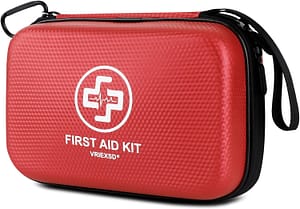
A go bag first aid kit is a scaled-down version of a home kit, focused on the injuries most likely during travel and evacuation rather than the full range of household medical needs.
The essentials are a tourniquet, an Israeli pressure bandage for serious wounds, closure strips, gauze pads, medical tape, a few plasters, nitrile gloves, and pain relief. A compact trauma kit that assembles these items in a labelled pouch is more practical than loose items in a bag where speed of access matters.
Include a three-day supply of any prescription medications, stored in a waterproof container. If you have an auto-injector for a severe allergy, it belongs in the bag. A small amount of antihistamine and antidiarrhoeal medication rounds out the basics. The what should be in a first aid kit article covers the items most commonly missing from pre-assembled kits, most of which apply directly to a go bag context.
Light and power
A head torch is the most practical lighting option for a bug out bag because it leaves hands free. Carry spare batteries or a rechargeable model. A small backup torch is worth including as a redundancy since lighting failure in an unfamiliar location at night is a serious problem.
A compact power bank keeps phones charged for communication and navigation. A 10,000 to 20,000mAh power bank covers several full charges for most smartphones and weighs between 200 and 400 grams. Keep it charged at home so it is ready to go without needing to charge it before leaving.

Communication
A charged phone with a power bank backup handles most communication needs during an evacuation. What it does not handle is information access when mobile networks are congested or down.
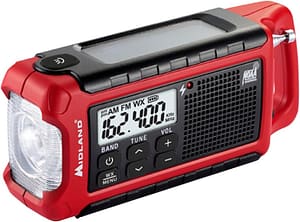
A compact emergency radio that fits in the bag and receives AM/FM and NOAA weather broadcasts keeps you connected to official updates without depending on data. Hand-crank models work without batteries as a backup. This is particularly important for longer evacuations where the situation may develop while you are in transit.
A written list of critical contact numbers, meeting points, and your destination address on a laminated card belongs in the bag. Phones get lost, damaged, or locked. A physical backup costs nothing and removes a potential point of failure.
Documents and cash
Keep copies of essential documents in a waterproof envelope or pouch: identification for each household member, insurance documents, a list of medications and medical conditions for anyone in the household, bank account details, and your emergency contact list. Original documents stay at home in a fireproof location. Copies go in the bag.
A small amount of cash in mixed denominations is essential. Card payments and ATMs both depend on functioning infrastructure. Physical currency works when nothing else does. The amount depends on your household but enough to cover one to two nights of accommodation and basic supplies is a reasonable target.
Tools and miscellaneous
A multi-tool covers a wide range of small practical problems, from cutting rope to opening cans to basic repairs, in one compact item. It is one of the highest utility-to-weight items in any bag.
A lighter and a small box of waterproof matches provide fire-starting capability for warmth, signalling, and boiling water. A whistle is a compact signalling tool that carries much further than a shouting voice and uses no energy.
A pair of work gloves protects hands during debris removal, vehicle assistance, or any physical task that a disruption might require. Heavy-duty nitrile gloves from the first aid kit double for this in a pinch but a pair of basic work gloves is a worthwhile addition.
Pets
If you have animals, their evacuation kit runs alongside yours. Compact supplies for a 72-hour evacuation with pets are covered in the how to prepare your pets for an emergency guide. The short version for the bag: three days of food in a sealed pouch, a collapsible bowl, any medications, and a copy of vaccination records. A cat carrier or dog lead needs to be accessible at the same time as the bag.
The bag itself
A 30 to 45 litre backpack is the right size for a single adult’s 72-hour kit. Smaller than 30 litres and you are making difficult compromises. Larger than 45 litres and weight becomes unmanageable for most people over any distance.
Choose a bag with a padded hip belt that transfers weight from the shoulders to the hips. This makes a meaningful difference over any distance beyond a short walk. Water resistance is more important than full waterproofing for most scenarios. An internal frame helps the bag hold its shape and distribute weight better than a soft frameless bag at this capacity.
Avoid bags with military or tactical styling if possible. A bag that does not draw attention is a practical advantage in a disruption scenario where resources may be scarce and visibility is not beneficial.
Where to store it and how to maintain it
Store the bag in a location everyone in the household knows, accessible without moving other things out of the way. Inside a wardrobe near the front door, under a bed, or in a hallway cupboard are all practical choices. If evacuation is ever necessary in the middle of the night, the bag needs to be reachable without a search.
Check the bag twice a year. Replace expired food and medications. Recharge the power bank. Verify the water filter has not been damaged. Confirm seasonal clothing still fits anyone who has grown since the last check.
The bag works best as part of a broader family emergency plan that specifies where to meet, where to go, and who is responsible for each bag and each household member. A bag that exists but that nobody has discussed is less useful than one that is part of a shared plan everyone understands.
A practical starting point
If you are building a bug out bag for the first time and want to start without buying everything at once, the items that give the most return immediately are a head torch with spare batteries, a Sawyer Mini water filter with purification tablets, two to three days of emergency food bars, a space blanket or bivy per person, a compact first aid kit with a tourniquet, a power bank, and a waterproof document pouch with copies of key documents.
That combination fits in a 20-litre bag, weighs under five kilograms, and covers the most critical needs for the first 72 hours away from home. Build the full kit from there at your own pace.
Still looking for more inspiration? Check our Amazon Store