

A power outage used to mean candles and a cold dinner. Today, a well-chosen portable power station can keep your fridge running, charge medical devices, maintain your internet router, and run basic lighting for one to several days. No permanent installation, no generator in the shed, no fuel to store.
This guide covers what actually matters when choosing a power station for household backup, compares six models all available on amazon, and helps you figure out how much capacity your household realistically needs.
What to Look for in a Home Backup Power Station
Capacity and output wattage dominate most product listings. Both matter, but there is more to evaluate before buying.
Capacity (Wh): how long will it last?
Capacity is measured in watt-hours (Wh). Divide the capacity by your device’s wattage and multiply by roughly 0.85 to account for inverter losses. That gives you real-world runtime.
Quick reference for a typical household:
- Fridge (average): 100 to 150W, so 1000 Wh gives you 6 to 8 hours
- Laptop: 45 to 65W, about 13 to 20 charges from 1000 Wh
- Phone: 18 to 30W, 30+ full charges from 1000 Wh
- CPAP without humidifier: 30 to 60W, 15 to 30 hours from 1000 Wh
- 4 LED lamps at 10W each: 20+ hours from 1000 Wh
- WiFi router (10 to 20W): 40+ hours from 1000 Wh
For a 72-hour outage covering essentials for 2 to 3 people, plan for at least 1500 Wh, used selectively. Running the fridge continuously doubles that requirement.
AC Output (W): what can you actually plug in?
The AC output determines what appliances you can run. Most devices list their wattage on the label or in the manual.
- 300W: phones, laptops, LED lights, router
- 800 to 1000W: fridge, TV, small microwave
- 1500 to 1800W: most kitchen appliances, power tools
Also check the peak or surge wattage. Some appliances, especially those with motors or compressors, require a burst of 2 to 3 times their running wattage to start. The station needs to handle that peak, not just the sustained load.
Recharge time
A station that takes 12 hours to recharge via wall outlet is inconvenient if grid power returns briefly. The current generation of mid-range stations from EcoFlow, Anker, Jackery, and Bluetti all offer recharge times under 2 hours via AC. This is now a baseline expectation, not a premium feature.
Battery chemistry: LFP is the standard
All six models recommended in this article use lithium iron phosphate (LFP / LiFePO4) batteries. LFP offers 3000 to 4000 charge cycles before capacity meaningfully degrades, compared to 500 to 800 cycles for older NMC chemistry. For something that sits in storage most of the year, this matters.
Weight and storage
The 1000 Wh-class stations weigh between 9 and 16 kg. Consider where this will live between outages. A unit in a utility room or under a desk is more likely to be ready and maintained than one buried in a storage attic.
6 Portable Power Stations Available on Amazon
All products below are available directly on amazon via their respective brand stores or fulfilled by Amazon. Prices fluctuate, especially during sales periods. Always verify current pricing before purchasing.
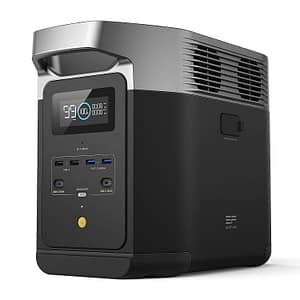
| EcoFlow DELTA 2 1024 Wh | 1800W AC output | LFP battery | 12 kg | Recharges to 80% in ~50 min The DELTA 2 is the most popular mid-range station for home backup use. It covers a fridge, lights, and devices for 6 to 8 hours, recharges very quickly, and can be expanded with an extra battery if needed. The 5-year warranty is a differentiator. Widely regarded as the benchmark in its price class. |
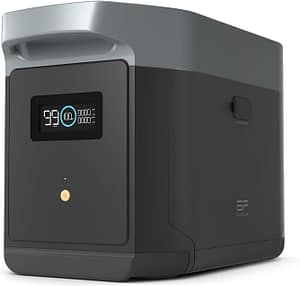
| EcoFlow DELTA 2 Max 2048 Wh | 2400W AC output | LFP battery | 23 kg | Sub-1 hr AC recharge Double the capacity of the standard DELTA 2, with 2400W output that handles most household appliances. A good fit for households that want 24+ hours of fridge coverage or need to run higher-draw devices. Heavier and pricier, but the value proposition is strong for larger families or those planning multi-day outage coverage. Expandable to 6 kWh with additional batteries. |
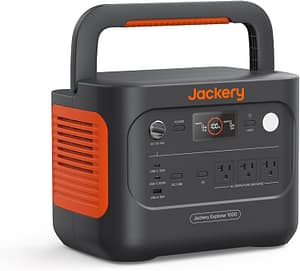
| Jackery Explorer 1000 v2 1070 Wh | 1500W AC output | LFP battery | 9.1 kg | 1-hour fast charge The lightest 1000 Wh-class station on this list. Jackery has strong brand recognition and is consistently one of the top-selling power station brands on amazon. The v2 upgrades the previous Explorer 1000 with LFP chemistry, faster charging, and a 100W USB-C port. Interface is simple and intuitive. A good all-round choice for households that prioritise portability alongside capacity. |
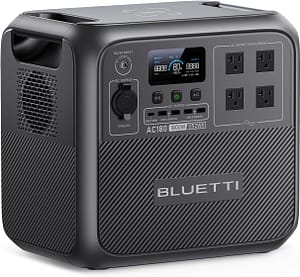
| Bluetti AC180 1152 Wh | 1800W AC output (2700W peak) | LFP battery | 10.8 kg | 0-80% in 45 min The Bluetti AC180 consistently scores well in multi-product comparisons for value per watt-hour. At 1152 Wh with 1800W output and a fast AC recharge, it covers all the bases for a mid-size household. Wi-Fi connectivity and wireless charging are practical extras. The 4000-cycle LFP rating is the longest on this list. |
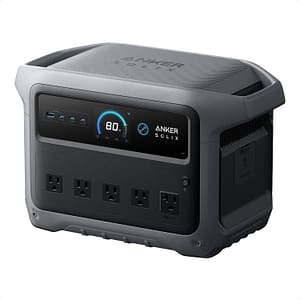
| Anker SOLIX C1000 Gen 2 1024 Wh | 2000W AC output (3000W peak) | LFP battery | 13 kg | Full charge in 49 min The fastest-charging station on this list. Anker holds a verified record for the fastest full recharge in the 1 kWh class at 49 minutes via its HyperFlash input. The 2000W continuous output (3000W peak) gives it the most headroom for high-draw appliances in this capacity range. Compact relative to its output. A strong choice if recharge speed is a priority, for example if you expect brief windows of grid power during a longer outage. |
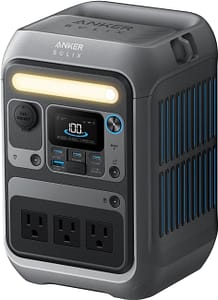
| Anker SOLIX C300 288 Wh | 300W AC output (600W peak) | LFP battery | 3.5 kg | ~1 hr recharge The most accessible entry point on this list. At under 4 kg and around 300 Wh, this is not a fridge-backup station. It covers phones, a laptop, LED lights, and a router through a short outage. For smaller households, apartments, or as a first preparedness purchase before stepping up to a larger unit, it is a sensible and affordable starting point. Also available as a DC-only version at a lower price. |
Comparison at a Glance
The table below summarises all six models on the key specs for home backup use.
| Model | Capacity | AC Output | Weight | Price tier |
| EcoFlow DELTA 2 | 1024 Wh | 1800W | 12 kg | €€€ |
| EcoFlow DELTA 2 Max | 2048 Wh | 2400W | 23 kg | €€€€ |
| Jackery Explorer 1000 v2 | 1070 Wh | 1500W | 9.1 kg | €€€ |
| Bluetti AC180 | 1152 Wh | 1800W | 10.8 kg | €€€ |
| Anker SOLIX C1000 Gen 2 | 1024 Wh | 2000W | 13 kg | €€€ |
| Anker SOLIX C300 | 288 Wh | 300W | 3.5 kg | € |
Price guide: € = under €250 | €€ = €250 to €500 | €€€ = €500 to €900 | €€€€ = €900+
Which Station Fits Your Household?
Apartment or 1 to 2 person household
If you rent, live in a smaller space, or just want to keep essentials covered during a typical grid blip, the Anker SOLIX C300 is a practical and affordable starting point. For more capability, the Jackery Explorer 1000 v2 is the lightest 1 kWh option and easy to store.
Mid-size household (2 to 4 people)
The EcoFlow DELTA 2 and Bluetti AC180 are the natural picks at this household size. Both offer around 1100 Wh with 1800W output and fast recharge. The DELTA 2 has a slight edge in brand recognition and ecosystem support (expandable battery, solar compatibility). The AC180 offers slightly more capacity and a longer cycle life for a comparable price.
The Anker SOLIX C1000 Gen 2 is worth considering if recharge speed is a priority. In a scenario where grid power returns for 45 minutes and then fails again, being able to fully recharge in that window is a real practical advantage.
Larger households or medical device users
For households with a CPAP, home oxygen concentrator, or nebuliser alongside normal household loads, the EcoFlow DELTA 2 Max at 2048 Wh and 2400W output gives the most headroom. It handles high-draw devices without throttling and provides enough capacity to cover a full day of essential appliance use.
First preparedness purchase, limited budget
The Anker SOLIX C300 keeps the entry cost low and still handles the most critical use case: keeping phones charged, a router running, and a few lamps lit during a short outage. It is a better starting point than a larger station that sits unused because the cost felt too high to justify.
Solar Charging: Worth Adding?
All six stations support solar panel input. For typical outage scenarios, where most grid failures last hours rather than days, wall-outlet recharging is faster and simpler. Solar becomes more relevant for extended outages caused by major storm damage or regional grid failure.
If you want to add solar, a 200W panel charges a 1000 Wh station in 5 to 7 hours under good conditions. Budget 8 to 12 hours for a full charge in autumn or winter sun.
EcoFlow, Jackery, Bluetti, and Anker all sell compatible solar panels on amazon. Buying the same brand as your station avoids compatibility issues and ensures passthrough charging works correctly.
Practical Tips Before You Buy
- Calculate your actual wattage needs first. List the devices you want to run, look up their wattages, add them up, and multiply by the hours you want coverage. This tells you the minimum Wh to look for.
- Test the station when it arrives, before you need it. Run a full charge and discharge cycle. Confirm it powers your planned devices. Do not leave this until a storm is on the forecast.
- Store it at 30 to 60 percent charge. LFP batteries prefer partial charge during long-term storage. Check the manual for the exact recommendation.
- Recharge every 3 to 6 months. Leaving an LFP battery fully discharged for extended periods causes permanent capacity loss.
- Keep it at room temperature. Cold temperatures reduce output capacity significantly. Heat accelerates long-term degradation. A utility room or under-desk location is ideal.
What a Power Station Does Not Replace
A portable power station is not a whole-home backup solution. It will not run electric heating, an electric boiler, or a full induction kitchen. During an extended regional outage, it is one element of a broader preparedness approach.
A practical household setup pairs a power station with a stock of emergency lighting, a battery-powered or hand-crank radio for information, sufficient drinking water stored, and food that does not depend on refrigeration.
Recommendations Summary
- Best overall (mid-size household): EcoFlow DELTA 2 or Bluetti AC180
- Best for apartments and light use: Jackery Explorer 1000 v2 (most portable) or Anker SOLIX C300 (budget)
- Best for large households or medical devices: EcoFlow DELTA 2 Max
- Best for fast recharge priority: Anker SOLIX C1000 Gen 2
- Best entry-level first purchase: Anker SOLIX C300