

When tap water becomes unsafe or your stored supply runs out, you need to know how to make water drinkable from whatever source is available. The options are not complicated, but they are not interchangeable either. Each method removes different contaminants, has different requirements, and suits different situations.
This guide covers every practical purification method in plain terms: what it removes, what it misses, and when to use it. If you are looking for specific product recommendations, see our emergency water filter comparison after reading this. Understanding the water purification methods first means you will know exactly what you are buying and why.
Quick comparison
No single method removes everything. The right choice depends on your water source and what contaminants are likely present.
| Method | Bacteria | Viruses | Protozoa | Chemicals |
| Boiling | Yes | Yes | Yes | No |
| Chlorine tablets | Yes | Yes (slow) | Limited | No |
| Iodine tablets | Yes | Yes | Limited | No |
| Filtration (0.1µ) | Yes | No | Yes | Partial |
| Filtration (0.02µ) | Yes | Yes | Yes | Partial |
| UV treatment | Yes | Yes | Yes | No |
| Boiling + filter | Yes | Yes | Yes | Partial |
Boiling
Boiling is the most reliable emergency water treatment method available and requires no equipment beyond a heat source and a container. It kills all biological contaminants: bacteria, viruses, and protozoa including Giardia and Cryptosporidium. It does not remove chemicals, heavy metals, or sediment.
How to do it correctly: bring water to a rolling boil for one minute. At elevations above 2,000 metres, boil for three minutes because water boils at a lower temperature at altitude and pathogens survive longer. Allow to cool naturally before drinking. Do not add ice unless you are certain the ice is made from safe water.
When boiling is the right choice: whenever you have a heat source and time. During a power outage, a camping stove, a gas hob, or a wood fire all work. Boiling is the fallback when you have no other treatment method and the most trustworthy option when the contamination source is unknown.
Limitation: it does nothing for chemical contamination. If your water source may have been contaminated by fuel, agricultural runoff, or industrial chemicals, boiling makes the biological situation safe but does not address the chemical one. Chemically contaminated water requires activated carbon filtration or a fresh source.
Chemical treatment
Chemical purification uses tablets or liquid drops to kill biological contaminants. It is lightweight, compact, requires no equipment beyond the chemical itself, and is a sensible addition to any emergency kit or go-bag.
Chlorine tablets
Chlorine tablets (sodium dichloroisocyanurate, or NaDCC) are the most widely available and easy to use. One tablet typically treats one litre of water. Add the tablet, wait 30 minutes, and the water is safe to drink. In cold water below 10°C or very cloudy water, extend the wait to 60 minutes.
Chlorine is effective against bacteria and viruses. It is less effective against Cryptosporidium, a protozoan parasite that is resistant to standard chlorine concentrations. For water from known clean municipal sources during a boil alert, chlorine tablets are sufficient. For water from rivers, streams, or flood-affected sources, add filtration.
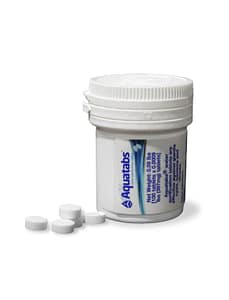
Aquatabs are the most widely distributed brand and meet WHO standards. They are available in sizes from 1-litre to 1,000-litre treatment tablets. For household emergency use, the 1-litre tablets are the most practical.
Iodine tablets
Iodine tablets work similarly to chlorine and are effective against bacteria and viruses. They are not recommended for regular long-term use due to thyroid effects, should not be used by pregnant women or people with thyroid conditions, and leave a noticeable taste. They are a reasonable backup option but chlorine tablets are preferable for most household preparedness purposes.
Bleach (sodium hypochlorite)
Unscented household bleach at 6-8% sodium hypochlorite concentration can be used to treat water in an emergency. Add 8 drops per litre of clear water, or 16 drops per litre of cloudy water. Wait 30 minutes before drinking. This is a last-resort option when tablets are unavailable. Do not use scented bleach, colour-safe bleach, or bleach with added cleaners.
Filtration
Filtration removes contaminants by forcing water through a physical membrane with pores small enough to trap pathogens and particles. The pore size determines what gets removed. A 0.1-micron filter removes bacteria and protozoa but not viruses. A 0.02-micron filter removes bacteria, protozoa, and viruses. For a detailed breakdown of specific filter products and which situations each suits best, see our emergency water filter comparison.
Hollow fibre filters (straw and squeeze filters)
Hollow fibre filters like the LifeStraw and Sawyer Squeeze work by passing water through thousands of tiny hollow fibres with 0.1-micron pores. They remove bacteria and protozoa to a very high standard (99.9999% for bacteria) and most are rated for hundreds of litres before replacement.
Their limitation is viruses. In most home emergency scenarios in developed countries, where the water source is municipal supply or a known clean groundwater source, viruses are not the primary concern. For flood water, river water, or any source that may have been contaminated with sewage, a virus-rated purifier is the safer choice.
Gravity filters
Gravity filters pass water from an upper container through a filter element into a lower container without any pumping. They are slower than straw or squeeze filters but require no effort once set up and can process larger volumes. The Platypus GravityWorks and similar systems are practical for household use during extended outages when you need to treat several litres at a time. Most gravity filters use 0.1-micron hollow fibre elements with the same virus limitation.
Activated carbon filters
Activated carbon reduces chlorine taste, some heavy metals, and certain organic chemicals. It does not remove bacteria, viruses, or protozoa reliably on its own. Carbon filtration is often combined with hollow fibre or UV treatment in multi-stage filters to address both biological and chemical contamination. If your concern is chemical contamination from industrial sources or agricultural runoff, activated carbon is part of the solution but not the whole answer.
UV treatment
Ultraviolet light treatment destroys the DNA of bacteria, viruses, and protozoa, preventing them from reproducing and rendering them harmless. Devices like the SteriPen use a UV bulb immersed directly in water and treat one litre in about 60 to 90 seconds.
What it removes: all biological contaminants including viruses and Cryptosporidium. It does not remove sediment, chemicals, or heavy metals, and it does not work effectively in very cloudy water because particles shield pathogens from the UV light.
Practical considerations: UV devices require batteries or USB charging, which means they depend on having backup power. They also require clear water to work effectively. For cloudy water, filter first to remove sediment, then treat with UV. The SteriPen is a practical addition to a go-bag but less suited to extended home use without a reliable power source.
Combining methods for complete protection
The most thorough approach combines two methods to cover the gaps of each. For most emergency preparedness purposes, one of these two combinations covers all realistic scenarios:
Filter plus chemical treatment
Filter first to remove sediment, bacteria, and protozoa, then add a chlorine tablet to kill any viruses that passed through. This combination works with any 0.1-micron filter and is effective for flood water, river water, or any unknown source. It is slower than UV treatment but does not require a power source.
Filter plus UV treatment
Filter first to clear sediment and remove bacteria and protozoa, then treat with UV to kill viruses. This is faster than chemical treatment and leaves no chemical taste. It requires batteries or a charged device. Suitable for go-bags and shorter-term use where power is available.
Boiling as the reliable fallback
When no filter or treatment chemicals are available and you have a heat source, boiling remains the most dependable single-step method for biological safety. It is the right choice in any situation where the contamination source is unknown and you cannot combine methods.
What purification does not fix
Every method described above addresses biological contamination. None of them reliably removes:
- Heavy metals such as lead or arsenic
- Industrial chemicals or fuel contamination
- Agricultural chemicals including pesticides and herbicides
- Salt (desalination requires distillation or specialist equipment)
If your water source may contain chemical contamination, the safest approach is to find a different source. Activated carbon filtration reduces some organic chemicals and chlorine taste but is not a comprehensive solution for chemical contamination. When in doubt about the source, use stored water.
Practical recommendations by scenario
Boil alert from your water utility: chlorine tablets or boiling. The source is treated municipal water with a specific biological concern. Chemical or heat treatment is sufficient.
Extended power outage, tap water still flowing but uncertain: a 0.1-micron filter like the Sawyer Squeeze handles bacteria and protozoa. Add chlorine tablets for virus coverage if concerned about sewage contamination.
Flood-affected area, unknown water sources: filter first to remove sediment, then treat with chlorine tablets or UV. Assume the worst about the source and use full-spectrum treatment.
Go-bag or evacuation: a straw filter or squeeze filter plus a small supply of Aquatabs. Compact, lightweight, and covers most realistic scenarios.
Extended home storage running low: a gravity filter for throughput plus Aquatabs as backup. This combination treats larger volumes without requiring a power source.
What to have at home
For most households, a modest water treatment kit covers all realistic scenarios. Our recommendation is to have at least one of: a quality hollow fibre filter like the Sawyer Squeeze or LifeStraw Peak Series, a supply of 100 Aquatabs, and a backup of unscented bleach stored with your emergency supplies. Together these cover biological contamination from any available water source without depending on a power supply.
Pair your treatment capability with adequate water storage and the right storage containers. Purification and storage are two different layers of water preparedness and both matter.