

If you have looked into water filtration for emergencies, you will have noticed quickly that the options are not straightforward. Gravity filters, pump filters, squeeze filters, straw filters, purification tablets, UV pens. Each one solves a slightly different problem, and the marketing rarely explains which problem is yours.
This article compares the three most practical options for household emergency preparedness: gravity filters, pump filters, and purification tablets. It covers how each one works, what it is good for, where it falls short, and which situation it suits best.
What all three have in common
Before comparing them, it helps to understand what they share. All three methods make water safer to drink by removing or neutralising pathogens. None of them require electricity. All three are practical for home storage and emergency kit use. And none of them are a substitute for stored water. Filtration is the layer you rely on when your stored supply runs out or becomes unreliable, not the first line of defence.
If you have not sorted your water storage yet, that belongs before filtration in the priority order.
Gravity filters
A gravity filter uses two containers connected by a filter element. You fill the upper container with untreated water, hang it above the lower container, and gravity does the work. No pumping, no squeezing, no electricity. You set it up and come back to clean water.
The practical advantage for households is volume. A 4-litre gravity system like the Platypus GravityWorks can process its full capacity in under three minutes and run continuously as long as you keep refilling the upper bag. For a family of four during a multi-day outage, that is the most realistic way to keep a meaningful supply of clean water moving through your setup without constant manual effort.
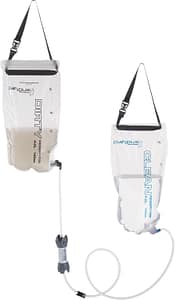
The tradeoff is that gravity filters are slower than pump filters when you need water immediately, and they require something to hang from. In a home setting neither of those is a serious constraint. In an evacuation or a scenario where you are moving around, it becomes more relevant.
Gravity filters use hollow fibre membranes that remove bacteria, protozoa, sediment, and microplastics down to 0.2 microns. They do not remove viruses. For emergency home use in countries with treated municipal water, that is sufficient for almost all realistic scenarios. If you are treating flood water or water from an unknown source with possible sewage contamination, a purifier that also covers viruses is the more appropriate choice.
Gravity filters are the right choice for home base use during extended outages, families who need to process larger quantities, and situations where you have time to let the filter run without supervision.
Pump filters
A pump filter uses a manual pump to push water through a filter cartridge. You place the intake hose in the water source, pump the handle, and filtered water comes out the other end into your container.
The key advantage over gravity is control and speed. You are not dependent on finding something to hang a bag from, and you can direct filtered water precisely where you want it. Pump filters also work well from shallow sources like puddles or small pools where you cannot submerge a gravity bag.
The Sawyer Squeeze is not a pump filter in the traditional sense but functions similarly in squeeze mode, and its 0.1 micron membrane is finer than most gravity options. For a dedicated pump with full purification including viruses, the MSR Guardian is the professional standard, though it sits at a significantly higher price point than the other options in this comparison.
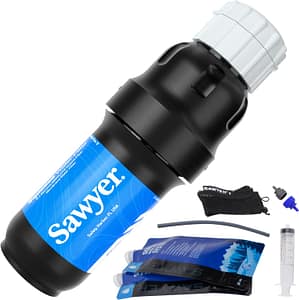
The tradeoff with pump filters is effort. Pumping water for a family of four through several days of an outage is physically tiring. They also have more moving parts than gravity or straw systems, which means more potential failure points over time.
Pump filters are the right choice for collecting water from shallow or awkward sources, situations where you need water quickly, and single or two-person use where the volume demands are lower.
Purification tablets
Purification tablets work differently from both filter types. Rather than physically removing pathogens through a membrane, they use chemistry to neutralise them. Chlorine dioxide tablets, such as Potable Aqua, kill bacteria and viruses on contact and are effective against most protozoa given sufficient wait time. You drop a tablet into the water, wait 30 minutes, and it is safe to drink.
The advantages are significant for an emergency kit: tablets are weightless, inexpensive, have a shelf life of up to four years unopened, and work regardless of what else has failed or gone missing. If your filter is broken, lost, or impractical to use, tablets are your backup.
The limitations are also real. Tablets do not remove sediment, microplastics, or chemical contaminants. The 30-minute wait time is not a problem in most home scenarios but becomes frustrating when you are thirsty and the situation is stressful. The taste is noticeable, though neutralising tablets that you add after treatment reduce it considerably. And chlorine dioxide tablets do not reliably cover Cryptosporidium at standard doses, which matters if your source water could be contaminated with that specific pathogen.
Purification tablets are the right choice for a backup in every emergency kit, situations where a filter is unavailable, and treating water from municipal sources where the main concern is bacterial contamination rather than sediment or parasites.
How to combine them
The most practical household approach is not to choose one method but to layer them.
A gravity filter at home handles the volume demands of daily use during an extended outage. A squeeze filter or personal straw filter in each household member’s go-bag covers individual needs if you are evacuating or separated. Purification tablets in every kit provide a zero-weight backup that works when everything else is unavailable or impractical.
This layered approach mirrors what the water purification methods article covers in more detail. The three methods are not competing options but complementary tools that cover different scenarios in the same preparedness plan.
The decision in plain terms
If you are buying one thing for home use during an extended outage and you have a household of more than two people, a gravity filter is the most practical choice. The Platypus GravityWorks 4L is the benchmark for this use case.
If you are building out individual emergency kits or go-bags, a squeeze filter gives you the most versatility in the smallest package. The Sawyer Squeeze or Sawyer Mini are the standard recommendations at this level.
If you want a backup that adds no meaningful weight or cost, purification tablets belong in every kit regardless of what filter you also carry.
For a full breakdown of specific products in each category including ratings, specifications, and price comparisons, the best emergency water filters guide covers all the options in detail.