

Most households have thought about emergency preparedness at some point. Fewer have actually written anything down or talked through what they would do. That gap is where things go wrong.
A family emergency plan is not a binder full of laminated documents. It is a shared understanding of what your household will do, where you will go, and how you will reach each other when normal communication fails. It takes about an hour to put together and needs revisiting once a year.
This guide walks through the two things that matter most: building a communication plan and deciding on meeting points. For the physical supplies side, the 72-hour emergency kit checklist covers what you need to have packed and ready.
Why most households are not ready
The assumption is that in an emergency you will be together, at home, with your phone working. None of those things are guaranteed.
A storm hits while one person is at work and another is picking up kids from school. A power outage takes down cell towers in your area. A fire or flood means you cannot return to your home. These are not extreme scenarios.
The first 24 hours of a major blackout are the highest-pressure window. Decisions get made fast, often without full information, and the households that have talked through a plan ahead of time navigate those hours with significantly less stress than those who haven’t.
Step 1: Decide on two meeting points
The single most useful thing you can do is agree on two locations before anything happens.
Meeting point 1: near your home. This is for scenarios where you need to evacuate the building quickly but can stay in the neighbourhood. The end of your street, a neighbour’s house, a nearby park. Somewhere everyone in your household can reach on foot in under five minutes.
Meeting point 2: further away. This is for scenarios where your neighbourhood is inaccessible: flood, fire, or extended evacuation. Choose somewhere familiar that everyone can reach independently: a family member’s home in another part of town, a specific public building, a town centre landmark.
Write both locations down with a full address. Do not rely on everyone remembering a vague description. If you have children, make sure they know both locations and can explain them to another adult.
The meeting point system serves one purpose: if you cannot reach each other by phone, everyone still knows where to go. It removes the need for real-time coordination in a situation where real-time coordination may not be possible.
Step 2: Build a communication plan
Phone networks are often the first thing to degrade during a large-scale emergency. Calls fail before texts do. Texts fail before messaging apps do. Messaging apps fail when data networks go down entirely.
A communication plan accounts for this degradation by giving your household options at every level.
Designate an out-of-area contact
Choose one person outside your region, a family member or close friend in another city, who everyone in your household will check in with if local communication fails. This person acts as a central relay: if two household members cannot reach each other directly, they can both contact this person and leave a message.
This works because long-distance calls are often more reliable than local ones during a regional emergency. Cell towers in the affected area may be overwhelmed, but towers elsewhere are functioning normally.
Make sure every household member has this person’s number memorised or written down somewhere they can access without their phone.
Write down the numbers that matter
Phones store hundreds of contacts. In an emergency, your phone may be dead, broken, or inaccessible. The numbers that matter most should be written on paper and kept somewhere accessible.
The list should include:
- Each household member’s mobile number
- The out-of-area contact
- Close neighbours
- Local emergency services number
- Your doctor or pharmacy
- Your insurance company
Keep a copy in each person’s go-bag and one posted at home, on the fridge or inside a kitchen cupboard.
Agree on a check-in window
If communication is difficult but not impossible, agree that everyone will attempt to make contact at a specific time, say, every two hours starting from when the disruption begins. This prevents household members from spending hours trying to reach each other continuously and conserves phone battery.
Step 3: Know your evacuation routes
Most households have one route they use for everything. During an emergency that route may be blocked, flooded, or congested.
Walk or drive two alternative routes from your home to each meeting point. Not just plan them on a map, actually use them once so everyone knows what they look like. Note any bottlenecks: bridges, tunnels, low-lying roads that flood.
If you live in an area at risk of flooding, this matters more than anywhere else. Our article on Our guide on
Step 4: Assign household roles
In a high-stress situation, unclear responsibility leads to inaction. Assigning roles in advance prevents the paralysis of everyone waiting for someone else to act.
Keep it simple:
- Who grabs the go-bags: One person is responsible for grabbing the pre-packed emergency bags on the way out.
- Who checks on neighbours: If you have elderly neighbours or anyone who might need help, assign someone to knock on their door.
- Who makes the first call: One person tries to reach the out-of-area contact and relays information.
- Who is responsible for pets: If you have animals, someone owns this task explicitly.
If you have children old enough to understand, involve them in the plan. Knowing what to do reduces fear significantly. Practise the route to the first meeting point with them at least once.
Step 5: Review the plan once a year
Phone numbers change. People move. Children grow up and get their own phones. A plan that was accurate two years ago may have gaps today.
Pick a fixed date each year, the start of autumn storm season is a natural moment to do this, and go through the plan together. Update contact numbers, confirm the meeting points still make sense, and check that the go-bags have not expired or been raided for camping trips.
What to have packed: go-bags and emergency radios
A communication plan and meeting points are worth nothing if you cannot act on them when the time comes. The two physical items that make the biggest practical difference are go-bags and an emergency radio.
Ready America 72-Hour Emergency Kit: 2 Person
Best pre-packed go-bag for most households
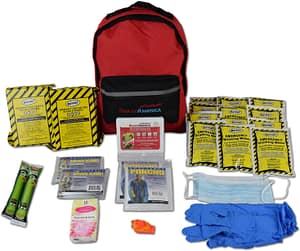
Ready America’s 2-person kit covers the basics without requiring you to research and assemble everything yourself. Inside: two 2,400-calorie food bars with a 5-year shelf life, 12 water pouches, two survival blankets, a 33-piece first aid kit, two 12-hour lightsticks, dust masks, nitrile gloves, a whistle, and ponchos, all packed in a backpack. It is not a premium kit and you will want to add your own prescription medication, phone charger, and copies of documents. But as a starting point for households who want something functional quickly, it covers the core bases.
- Two 2,400-calorie food bars, 12 water pouches, and survival blankets for 2 people
- Pre-packed backpack: no assembly required
- Add your own medications, phone charger, and document copies
Bottom line: The fastest way to get two people covered. Add your personal items and it is genuinely usable.
Ready America 72-Hour Deluxe Emergency Kit: 4 Person
Best for larger households
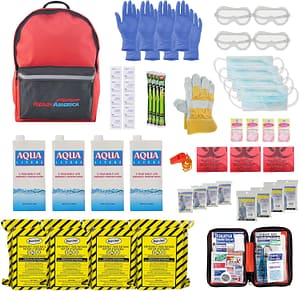
The 4-person deluxe version scales up for larger households and includes a portable power station alongside the food rations, water pouches, first aid kit, and survival blankets. For a household of three or four people this is more practical than buying two separate 2-person kits.
- Covers 4 people for 72 hours with food, water, first aid, and shelter basics
- More practical than two separate 2-person kits for larger households
Bottom line: The logical choice for households of three or four.
Midland ER210 Emergency Radio
Good emergency radio for home preparedness
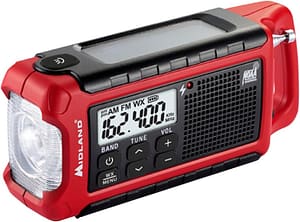
When cell networks go down, an emergency radio is one of the few ways to receive official broadcast updates. The Midland ER210 is consistently the top recommendation among emergency preparedness reviewers. It receives AM/FM radio, charges via USB, solar panel, or hand crank, and has a built-in LED flashlight with SOS beacon mode. The 2,200 mAh battery provides up to 25 hours of radio operation. Solar charging is slow and best used to top up the battery rather than fully recharge it. Keep it charged via USB and treat the solar and hand crank as backups.
- AM/FM radio with weather alert channels
- Three power sources: USB, solar, hand crank
- Built-in USB output port to charge phones and devices
- LED flashlight with SOS Morse code beacon mode
Bottom line: One per household, kept charged, stored with your go-bags. Buy it once and it will outlast most of the emergencies you will ever face.
FosPower A1 Emergency Weather Radio
Best budget emergency radio
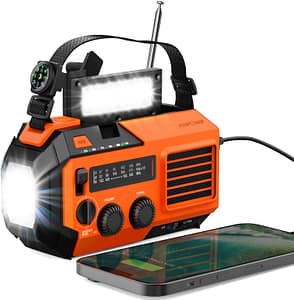
If the Midland is more than you want to spend, the FosPower A1 is the most reliable budget option. It covers AM/FM radio, charges via USB, solar, and hand crank, and includes a flashlight and SOS alarm. The battery capacity is smaller than the Midland and the build quality is a step down, but for households who want a functioning emergency radio at a lower price it does the job.
- AM/FM radio reception
- Three power sources: USB, solar, hand crank
- Flashlight and SOS alarm included
- Significantly lower price than the Midland
Bottom line: Solid choice if budget is the deciding factor. It works when you need it to.
The one-page household emergency plan
Everything above can fit on a single sheet of paper. Print it, fill it in, and keep it somewhere accessible, inside a kitchen cupboard, taped to the inside of your front door, or tucked into your go-bag.
| Meeting point 1 (near home) | Address: ___________________________ |
| Meeting point 2 (further away) | Address: ___________________________ |
| Out-of-area contact | Name: _____________ Number: ____________ |
| Household member 1 | Name: _____________ Number: ____________ |
| Household member 2 | Name: _____________ Number: ____________ |
| Household member 3 | Name: _____________ Number: ____________ |
| Emergency services | Your local emergency number (e.g. 911, 112, 999) |
| Check-in schedule | Every ___ hours from time of disruption |
| Go-bag location | ___________________________ |
| Who grabs the bags | ___________________________ |
| Who checks neighbours | ___________________________ |
| Plan last reviewed | Date: ___________________________ |
What to do right now
The plan does not need to be perfect to be useful. A rough plan that everyone in your household knows about is worth more than a detailed plan that exists only in your head.
Start with the two meeting points. Agree on them tonight. Write them down. That one step means that if something happens tomorrow, your household has a place to go.
From there, work through the 72-hour emergency kit checklist to make sure the physical supplies match the plan. A communication plan without water, food, and a working radio is still incomplete.