

Why your stored water supply needs a backup plan
If you have read our guide on how much water to store for emergencies, you already know the baseline: one gallon per person per day, minimum three days, ideally two weeks.
But stored water has a limitation. It runs out. In an extended emergency, a grid failure lasting more than a week, a prolonged boil alert, or an evacuation, you may need to collect and treat water from sources you would not normally drink from.
That is where emergency water filters come in. They are not a replacement for stored water. They are the next layer when your stored supply is not enough.
A filter also gives you a practical option if your stored water develops an off-taste over time, or if a pipe failure contaminates your tap supply before the water reaches your containers.
Filter vs purifier: what the difference means in practice
The two terms are often used interchangeably but they mean different things.
A filter removes bacteria, protozoa, sediment, and microplastics through a physical membrane. It does not remove viruses. For most home emergency use in developed countries, where municipal water is the starting point, a filter is sufficient.
A purifier removes bacteria, protozoa, and viruses. Purifiers use finer membranes (0.02 microns vs 0.1–0.2 microns for filters), UV light, or chemical treatment. They are the correct choice if you are treating water from unknown sources, rainwater, or any situation involving potential sewage contamination. Read this article next to choose the right purifier.
For household preparedness in North America or Western Europe, a quality filter handles most realistic emergency scenarios. If you live in an area prone to flooding that could contaminate groundwater, or if you are building a kit for travel to regions with different water safety standards, a purifier is the better investment.
The four types of emergency water filtration
Straw and squeeze filters
The simplest personal option. You drink directly through the filter from a water source, or squeeze water through it into a container. Lightweight, no moving parts, no electricity required.
Best for: individual use, emergency kits, evacuation bags. Limitation: slow output, designed for one person.
Gravity filters
A two-bag system: you fill the dirty-water bag, hang it, and let gravity pull water through the filter into a clean reservoir below. No effort required once set up, and output is high enough for a household.
Best for: home base use, families, situations where you have time to wait. Limitation: slower than pump or squeeze systems, requires something to hang from.
Pump filters
Manual pumps that push water through a filter cartridge. Fast output and precise control over where water goes. The MSR Guardian is the benchmark in this category and is also a full purifier.
Best for: collecting water from shallow sources like puddles or shallow streams. Limitation: requires physical effort, more moving parts.
Chemical purification tablets
Chlorine dioxide tablets kill bacteria, viruses, and most protozoa. Lightweight, long shelf life, and inexpensive. The tradeoff is wait time (30 minutes minimum) and a slight chemical taste.
Best for: backup option in an emergency kit, situations where a filter is unavailable. Limitation: does not remove sediment or microplastics, taste is noticeable.
Recommended products by use case
Best overall personal filter: LifeStraw Peak Series
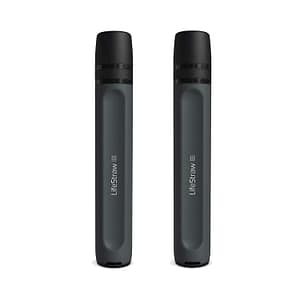
Type: Straw filter Filtration: 0.2 microns, removes bacteria, protozoa, and microplastics Capacity: 4,000 liters (approximately 5 years of personal use) Weight: 57g
The LifeStraw Peak is the updated version of one of the most recognized emergency filters on the market. It screws onto standard water bottles, works as a straw directly from a source, or can be used inline with a gravity setup. No moving parts. Nothing to replace until you have filtered over a thousand gallons.
It does not remove viruses, which is worth noting for travel but is rarely a concern for emergency home use in countries with treated municipal water supplies. The filter meets EPA and NSF standards.
Good for: every household emergency kit and evacuation bag.
Best value personal filter: LifeStraw Original
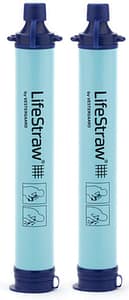
Type: Straw filter Filtration: 0.2 microns Capacity: 4,000 liters Weight: 45g
The original LifeStraw is one of the most affordable emergency filters available. It works only as a straw (not a bottle attachment), which limits its versatility compared to the Peak series. For a basic emergency kit or a second filter to keep in a go-bag, it is hard to beat on price.
Best squeeze filter: Sawyer Squeeze
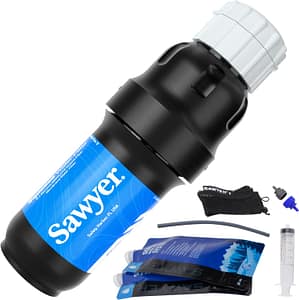
Type: Squeeze / inline filter Filtration: 0.1 microns, removes bacteria, protozoa, and microplastics Capacity: 100,000 gallons (effectively unlimited) Weight: 85g
The Sawyer Squeeze is widely regarded as the most versatile personal filter available. The 0.1 micron membrane is finer than most comparable products. It attaches to any standard threaded water bottle, comes with collapsible pouches, and can be configured as a gravity filter by hanging the pouch above a container.
The backwash function restores flow rate when the filter slows down, which extends its useful life significantly. The Sawyer Squeeze is the better choice if you want one filter that can handle personal use, group use as a gravity setup, and long-term storage without degradation.
Best compact backup: Sawyer Mini

Type: Straw / inline filter Filtration: 0.1 microns Capacity: 100,000 gallons Weight: 56g
Same filtration performance as the Squeeze in a smaller format. The tradeoff is a slightly slower flow rate. For an emergency kit where space and weight matter, the Mini is the right call.
Best purifier (removes viruses): Grayl UltraPress

Type: Press bottle purifier Filtration: 0.02 microns, removes bacteria, protozoa, viruses, chemicals, and heavy metals Capacity: 300 liters per cartridge Weight: 350g
The Grayl UltraPress is in a different category from the filters above. It removes viruses, chlorine, heavy metals, and chemical contaminants in addition to bacteria and protozoa. You fill the outer bottle, press the inner vessel down, and filtered water collects in the bottom in about 10 seconds.
It is more expensive to run than a hollow fiber filter because cartridges need replacing every 300 liters. But it is the most thorough point-of-use purifier available at this price point, and the press-bottle design is faster and easier to use than straw filters.
Best for: households in flood-prone areas, anyone preparing for scenarios involving sewage contamination, or use alongside tap water during a prolonged boil alert.
Best gravity filter for households: Platypus GravityWorks 4L
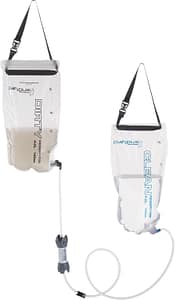
Type: Gravity filter Filtration: 0.2 microns Capacity: 1,500 liters per filter element Output: Approximately 1.75 liters per minute
The Platypus GravityWorks is a two-bag gravity system designed for groups. You fill the 4-liter dirty bag, hang it, and filtered water flows into the clean reservoir below with no effort. It can process its entire capacity in under three minutes, which makes it practical for household use when you need to filter large quantities.
It is bulkier than personal filters but significantly more practical for a family situation during a multi-day outage. Pair it with your water storage containers to keep a clean supply cycling through.
Best chemical backup: Potable Aqua Purification Tablets
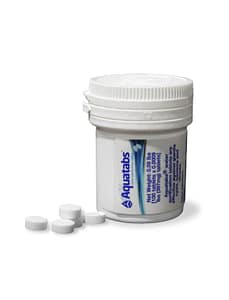
Type: Chlorine dioxide tablets Treats: Bacteria and viruses (not Cryptosporidium) Shelf life: 4 years unopened Weight: negligible
Potable Aqua tablets should be in every emergency kit as a backup. They add no weight, cost very little, have a long shelf life, and work when a filter is broken, lost, or unavailable. The 30-minute wait time and slight taste are the main drawbacks.
Note: chlorine dioxide tablets do not remove Cryptosporidium. For full protozoa coverage, pair tablets with a hollow fiber filter or use them only for water from treated municipal sources.
What to look for when choosing
Filtration level. For home emergency use in developed countries, 0.1 or 0.2 micron hollow fiber is sufficient for tap water, rain collection, and most freshwater sources. For flood water or unknown sources, look for a purifier that also covers viruses.
Flow rate. Personal straws and squeeze filters are fine for one or two people. For a family of four during a multi-day outage, a gravity filter with a 4-liter capacity is far more practical.
No electricity required. Every filter recommended in this guide works without power. That is a design requirement for emergency use. Avoid UV purifiers unless you can guarantee battery availability.
Shelf life when not in use. All hollow fiber filters degrade if stored wet. Dry your filter before long-term storage and store it as directed by the manufacturer. Most have an indefinite shelf life when stored dry.
Running cost. Hollow fiber filters like the Sawyer and LifeStraw have no replaceable cartridges and can last for the life of the product. The Grayl UltraPress requires cartridge replacement every 300 liters, which adds ongoing cost.
How to build a layered water strategy
The most practical household setup combines stored water with filtration capacity:
Layer 1 : Stored water. Follow the guidance in our water storage guide and store a minimum of one gallon per person per day for at least three days in proper food-grade containers.
Layer 2 : Personal filter per person. A Sawyer Mini or LifeStraw in each household member’s emergency kit or evacuation bag covers individual needs if you are separated or evacuating.
Layer 3 : Household gravity filter. A Platypus GravityWorks or similar system at home allows you to process large quantities from any freshwater source without effort.
Layer 4 : Chemical backup. A pack of Potable Aqua tablets in your kit covers the situation where your filter is unavailable, damaged, or impractical to use.
Combined, this setup covers a household through any realistic disruption scenario without depending on bottled water, municipal supply, or electricity.
Bottom line
For most households, the Sawyer Squeeze is the best single investment: versatile, affordable, near-unlimited capacity, and usable as both a personal and group filter. The LifeStraw Peak is the better choice if simplicity and minimal weight are the priority.
Add a Platypus GravityWorks for family-scale home use, and keep a pack of purification tablets in every kit as a no-weight backup.
Water filtration is not a standalone solution. It works best as part of a broader preparedness plan that includes stored water, reliable lighting, and backup power. If you have not read our guide on how much water to store or our 72-hour emergency kit checklist, those are the logical next steps.